

سفير تركيا
Active member
- Joined
- Dec 14, 2025
- Messages
- 127
- Reaction score
- 0
- Points
- 16
 Shipping to the UAE: establish where the goods enter and who receives them
Identify the emirate, entry point, importer and procedure before calculating charges or promising relief

The entry point and purpose determine the shipment file and procedure. — General illustrative photo.
Selecting the UAE at checkout is not enough to establish the order’s import procedure. Entry into the domestic market differs from entry into a free zone, warehouse or reexport procedure, and a commercial importer has a role separate from the carrier. This guide uses current Dubai Customs services as a practical example; consult the competent authority if goods enter through another emirate. For tax purposes, a free zone is not automatically a VAT designated zone, nor does it mean that domestic stock sales are exempt. Start by mapping the goods’ movements, identifying the importer and compiling the product file, then request a quote showing costs and responsibilities. All amounts in the financial example below are hypothetical.

 Identify the emirate, entry point and purpose
Record the customer’s city, arrival point and party handling clearance, then establish the purpose: sale to a consumer, supply to a trader, free-zone stock, reexport or temporary admission. These details determine the declaration type, documents and party responsible for charges. A small box of commercial inventory does not become a personal shipment because it travels by express service, and a sample for display does not automatically follow the procedure for an outright sale.
If the proposed route begins in Dubai and the goods then move to another emirate or country, ask about each movement and its evidence. Do not apply Dubai’s registration code or service fees indiscriminately to every UAE entry point. Ask the carrier to name the service, procedure and local authority involved. The contract should specify where its responsibility ends and the importer’s or warehouse’s work begins. If the route is still unclear, do not add ‘all charges included’ to the product page. Settling the movements first makes the price workable and follow-up clearer when delays occur.

 Choose between domestic entry and overseas stock
You may ship each order directly from Türkiye, supply a quantity to a local importer, or hold stock in a free zone for a defined purpose. Direct sales keep inventory in one place but repeat international shipping procedures for each order. Local inventory may shorten customer delivery, but requires lawful importation, accounting and stock that may remain unsold.
A free zone suits some storage and reexport models, but adds an operating contract and tracking of goods’ movements; it is not a guaranteed shortcut around tax or documentation. Identify who owns the goods, sells them and releases them into the domestic market. Compare the cost of a sold unit with an unsold unit, including storage, withdrawal, inspection and return charges. For an initial trial, choose one model whose file you can close rather than distributing a small quantity among several locations. Expand after establishing demand, actual costs and the conditions for recovering stock.
| Entry route | Key question | Execution file |
|---|---|---|
| Direct from Türkiye to the customer | Who is the importer, and who bears arrival charges? | Order, invoice, transport and declaration |
| Supply to the domestic market | Are the importer and its business activity eligible? | Commercial file and approvals |
| Free-zone entry | What is the purpose and next movement? | Entry declaration and stock record |
| Free zone to domestic market | Who submits the declaration and bears import responsibility? | Appropriate declaration and settlement of charges |
| Reexport or temporary admission | What are the closure conditions and time limit? | Correct procedure and proof of movement |

 Document importer eligibility and the agent’s role
Dubai Customs’ business registration service allows an establishment to register for a customs code and requires, among its documents, a license copy and details of the authorized person as specified in its requirements. The code does not replace eligibility for the business activity or permits for restricted goods. Match the legal name, license and number to the invoice and declaration, and identify who can authorize the broker and follow up on the transaction.
An agent or broker may prepare the declaration for the goods’ owner under the appropriate license and authorization; the carrier does not automatically become the importer of every product. Request the clearance party’s name, authorization method and proof of payment of charges in the quote. If your distributor purchases from you, the supply contract should explain when obligations transfer, who handles release and who deals with nonconforming goods. If a warehouse provides fulfillment services only, do not treat it as a purchaser or tax-bearing party without a clear agreement. Defining these roles protects collection records and makes responsibility for missing documents easier to identify.

 Prepare a file that matches the shipment
Dubai’s current declaration-submission service lists the invoice, packing list, certificate of origin and permit from the restricting authority where required among its documents. Ask the importer and broker to confirm the format required for your product and route, including whether originals, authentication or additional details are needed. The list does not waive category-specific requirements. The invoice must describe the goods, quantity, value, currency and parties as the sale actually occurred.
Prepare a technical sheet stating material, use, model, brand and evidenced country of manufacture. Link boxes to the packing list and transport waybill, and do not change quantities after issuing documents without updating the file. Keep a copy of the permit or conformity evidence for the actual product, rather than a general certificate for another brand. Check destination requirements for package information, language and product presentation before printing a large label batch. When a correction is requested, record the new version and reason so another team does not use an older copy.
| File component | What to match | Gap requiring a pause |
|---|---|---|
| Invoice | Description, quantity, value and currency | An amount or party inconsistent with the sale |
| Packing list | Parcel count and contents | A box without a clear link |
| Transport waybill | Names, entry point and reference | An inconsistent address or recipient |
| Origin | Required evidence and country of manufacture | Assuming the dispatch country is sufficient |
| Permit or conformity evidence | Product category, model and authority | A certificate for different goods |
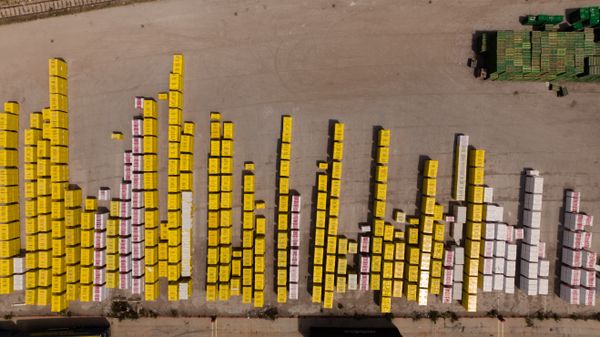
Stock held in a free zone requires tracking of its movements and documents. — General illustrative photo.

 Check origin and agreement treatment for the tariff classification
The Turkish Ministry of Trade confirms that the Türkiye–UAE Comprehensive Economic Partnership Agreement has been in force since the first of September 2023. The agreement does not mean that every item sent from Türkiye enters duty-free. Determine the tariff classification and review the treatment schedule, origin rules, required document and claim procedure for the goods concerned. A general announcement about the agreement cannot replace a product-specific check.
A Turkish supplier may sell goods manufactured outside Türkiye, and a product made in Türkiye may fail the preferential-origin rule required in a particular case. A ‘Made in Türkiye’ label does not replace evidence for preferential treatment. Request verifiable information from the supplier, then agree who supplies the accepted origin document. If evidence is incomplete, price using confirmed treatment without promising a potential reduction. Keep the country-of-origin explanation consistent on the invoice and packaging: discrepancies can prompt questions even when no preference is claimed.

 Distinguish a free zone from a tax designated zone
VAT designated zones have specific designation and conditions; they do not encompass every commercial free zone. Article 51 of the current consolidated Executive Regulation addresses conditions for the zone, goods’ movements, use and supply. Special treatment for certain movements of goods does not place the business itself or all its services outside VAT. Renting a free-zone warehouse alone does not answer every order’s tax questions.
Before adopting an inventory model, ask the accountant to establish the zone’s status and treatment on entry, during storage, on sale to the domestic market and on departure abroad. Keep evidence of the location, importer, movements and purpose, because use of the goods affects treatment. Movement into the domestic market requires assessment as an import according to the circumstances; obligations may arise even if nothing was paid when the goods entered the designated zone from abroad. Do not write ‘free zone, therefore no VAT’ on your website. State the price and its inclusions according to the actual route.
 A free-zone license does not guarantee customs or tax relief when goods are sold within the country.

 Establish VAT and how to handle it
The UAE’s standard VAT rate is five percent, with different treatments depending on the procedure and goods. Separate import VAT from tax that may apply to a subsequent sale, and identify the importer, registered party and links between its customs and tax details. Do not present a domestic registration threshold as a general exemption for a nonresident seller; assess the obligations of the party actually making the supply.
If an agent advances amounts for you, request a document identifying the authority, amount and transaction and provide it to the accountant rather than labeling all its charges ‘VAT’. Input-tax recoverability differs from cash payment on entry: you may pay an amount recoverable later subject to conditions, or bear an unrecoverable cost. Separate the two in profitability and cash-flow calculations. Do not deduct an expected recovery before its basis and evidence exist. Review treatment if the importer or warehouse route changes, or goods move from the zone to a domestic customer.

 Read a hypothetical landed cost line by line
Start with the goods’ value, transport and insurance to arrival under the appropriate customs valuation. Dubai’s guide explains the CIF basis, but the duty rate and any preference must be matched to the classification and circumstances. This example assumes domestic entry with duty of five percent on a value of 1120 dirhams, and standard VAT of five percent on 1176 dirhams under the assumed circumstances. It does not establish that these rates apply to every product or that the agreement grants relief.
The figures are: goods worth one thousand dirhams, transport of one hundred and insurance of twenty, giving an example value of 1120. Duty is 56, bringing the assumed base to 1176, with VAT of 58.80. Assume an all-in service and handling quote of 75 dirhams, including any tax on that service, which is not counted again. The hypothetical total cash outlay is 1309.80 dirhams. This figure describes this example only; actual quotes vary with the declaration, product, expenses and collection method. If VAT is recoverable, discuss its accounting effect while preserving the correct cash-flow effect.
| Hypothetical item | UAE dirhams | Reason for inclusion |
|---|---|---|
| Goods’ value | 1000.00 | Declared sales value |
| Transport to arrival | 100.00 | Included in the example’s base |
| Insurance | 20.00 | Included in the example’s base |
| Assumed CIF value | 1120.00 | 1000+100+20 |
| Assumed duty of 5% | 56.00 | 1120×5% |
| Assumed VAT base | 1176.00 | 1120+56 |
| VAT5% | 58.80 | 1176×5% |
| Total service and handling | 75.00 | Hypothetical quote including its tax |
| Total cash outlay | 1309.80 | 1176+58.80+75 |

The finished parcel must match the invoice and packing list. — General illustrative photo.

 Ask the carrier to define its service scope
Before requesting a price, send the product description, value, weight, box dimensions, entry point, city and purpose. State whether delivery is to a free zone or domestic address and identify the importer whose role has been established. Request a list of inclusions and additional charges for inspection, storage or address changes. Volumetric weight, the service’s calculation factor and remote-area charges can change order costs even when actual weight stays the same.
If the quote is described as DDP, look beyond the abbreviation. Verify the seller’s capability and arrangement to complete importation and pay duties and tax within the quote’s terms and local law. Under DAP, explain the buyer’s import obligations and charges as agreed, specifying the delivery place and agreed edition. A trade term does not guarantee importer eligibility or product licensing. Carrier transit time differs from clearance time; separate the estimates in customer messages and maintain a channel for document requests before storage charges accumulate.

 Track the declaration, delivery and next movement
Start with confirmation that the file was received, then the declaration number, type and details relevant to your goods, followed by approval, release and delivery. Approval of an electronic application does not guarantee same-day arrival at the customer. The competent authority may require review, a permit or inspection. Record any deficiency, the requesting authority and person responsible for responding, and retain confirmation of the new document’s submission.
For a free-zone model, also record quantities entering, moving to the domestic market, reexported and remaining. Matching warehouse records to declarations is part of the ability to scale, rather than work to defer until year-end. Do not use a single entry declaration to establish a later sale whose route is unclear. If the purpose changes from reexport to domestic sale, ask about the new declaration and treatment before releasing inventory. The following table is an operational tracker, rather than a statement of official durations or a uniform deadline for every procedure.
| Tracking stage | What to establish | Who responds |
|---|---|---|
| Before dispatch | Product and importer eligibility and route | Importer and broker |
| Declaration submission | Type, number and documents | Party authorized to submit |
| Review or deficiency | Specific request and latest version | Document owner |
| Release and delivery | Charges, evidence and address | Broker and carrier |
| Free-zone inventory movement | Quantity and declaration for each transfer | Warehouse, importer and accountant |
 Test returns and stock withdrawal
Before supplying a warehouse, ask about withdrawing unsold goods, reexporting or destroying them, and the work’s cost, duration and exit document. Do not assume reexport automatically recovers every amount paid; recovery or adjustment of charges follows the procedure, its conditions and evidence. If a product returns to Türkiye, prepare the link to its original export and its identity with the carrier and Turkish accountant.
Run a small trial that includes an imperfect outcome: the customer refuses charges, the address is incomplete or a return is requested. Establish how the case is opened, who can decide on storage or return, and how the refund is issued. Include the case’s loss in contribution and separate it from order revenue that appeared successful at payment. After the trial, choose one improvement: a verified all-inclusive price, an easier product, a better-prepared importer or clearer support. Expanding to overseas stock requires these answers and realistic demand expectations, beyond the appeal of ‘fast local delivery’.
 Required outcome: a defined entry procedure, eligible importer, documented VAT treatment and cash cost with explained components.
 Frequently asked questions and shipping checklist
Can a free-zone company sell stock domestically without a new declaration?
Moving goods into the domestic market requires the appropriate declaration and treatment. Establish the importer, business eligibility and charges before releasing goods from the warehouse.
Does Turkish origin mean zero duty under the agreement?
Check the tariff classification, origin rules, document and specific treatment. The dispatch country or a printed statement alone is insufficient to claim a preference.
Is VAT paid on entry always a final cost?
Its effect depends on recovery eligibility, the importer’s status and documents. Record cash paid separately from the accounting cost approved by the specialist.
 I identified the emirate, entry point, purpose and next movement. I documented the importer, its code and broker authorization where needed. I matched the invoice, packing, origin and permits. I distinguished free-zone status from designated-zone status. I obtained a quote explaining duty, VAT and service charges. I tested delivery, refusal and returns or stock withdrawal.
 Related topics
 Selling from Türkiye to Arab Markets: Market and Entry Strategy
- Micro-Exports from Türkiye: BGB, ETGB, Invoices and Export Evidence
- Shipping Contracts in Türkiye: Quotes, Coverage and Responsibilities
- Shipping Costs in Türkiye: Actual Weight, Volumetric Weight and DESI
- Shipping from Türkiye to Saudi Arabia: Personal and Commercial Imports
- Own Warehouse or Fulfillment in Türkiye: Costs, Contracts and Stock
- Domestic & International Shipping Services in Türkiye for E-Commerce
- Online Store Obligations in Türkiye: The Seller Compliance File
- International Pricing from Türkiye: Landed Cost, Currency and Margin