عناقيد
Active member
- Joined
- Oct 19, 2025
- Messages
- 116
- Reaction score
- 0
- Points
- 16
Türkiye’s 2027 Central Government Budget Bill has entered parliamentary consideration, but had not become an enacted law according to the status read on 20 October 2026. The parliamentary bill record confirms receipt on 16 October under number 1/282 and referral to the Plan and Budget Commission, with the status KOMİSYONDA; in committee. The schedule sets the executive presentation for 21 October at 14:30 Türkiye time. This is a planned appointment, not a report that a hearing or vote has taken place.
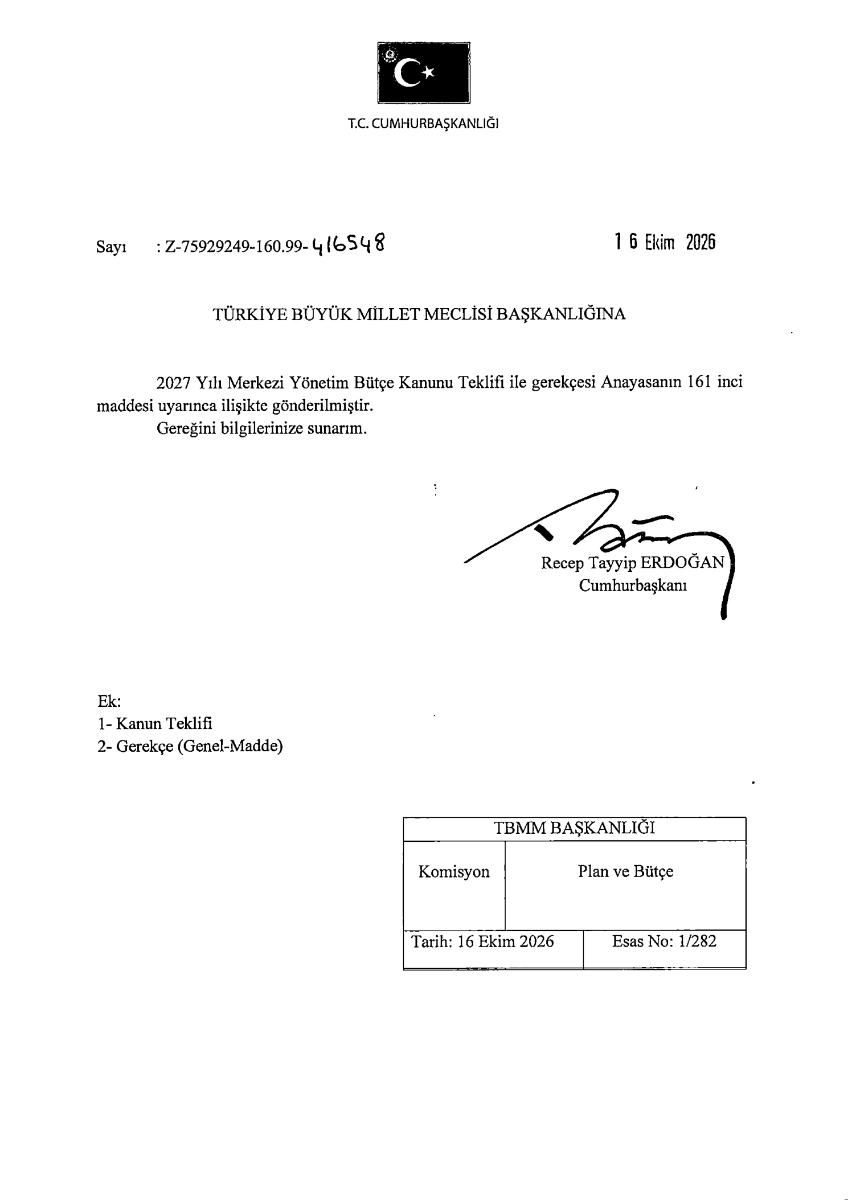 The first page of the 16 October 2026 referral letter, showing the Plan and Budget Commission and bill number 1/282. This is a bill-submission document, not minutes of 21 October or an enacted law. Open the complete official original to read the document at a larger size.
 Three different years in the same story
2026 is the year of submission and discussion; 2027 is the fiscal year addressed by the bill. The 2025 final accounts in the commission agenda concern review of an earlier year, rather than a newly proposed budget for that year. Discussing the two files in one meeting does not make their figures interchangeable or additive.
Likewise, a forward estimate for 2027 inside a 2025 or 2026 budget document is not the figure in the current bill. The document’s date, title and bill number matter more than finding the year in an isolated table. The cover letter cites Article 161 of the Constitution: 161 is a constitutional reference, while 1/282 is a bill identifier. Neither is a monetary amount.
 Reading appropriations and estimated revenue
A proposed appropriation is an amount provided in the bill for spending within its scope; it does not establish that the money has actually been spent. Estimated revenue is a forecast of collection, not receipts already paid into the Treasury. Distinguishing the terms prevents an annual plan from being reported as an achieved fiscal result.
Articles 1 and 2 divide the figures into three legal categories according to the schedules to Public Financial Management and Control Law No. 5018. The table retains the amounts as printed, in whole Turkish lira, without rounding to millions or trillions:
There is no consolidated-total row. These amounts belong to their legal categories; adding the columns does not by itself produce an independently verified consolidated central-government total, because some revenues include transfers between public bodies.
 Why Treasury transfers must not be counted twice
For special-budget administrations, estimated revenue comprises TRY 198,862,954,000 in own revenue and TRY 2,172,708,491,000 in Treasury aid, giving the stated total of TRY 2,371,571,445,000. Regulatory and supervisory authorities have TRY 110,804,422,000 in own revenue and TRY 4,415,149,000 in Treasury aid, totalling TRY 115,219,571,000.
A transfer to another body does not necessarily become new, independent revenue when accounts are consolidated. Treasury aid is therefore not added to general-budget revenue and described as a consolidated revenue total. Nor do we subtract only those transfers and assume that every consolidation adjustment has been completed without the supplementary schedules.
Article 2 also states net financing of TRY 1,338,450,000 for special-budget administrations. Financing is not synonymous with revenue and should not automatically be added to it. Article 3 addresses financing the difference within the general-budget category through net borrowing. This does not establish a consolidated deficit covering every category, a loan interest rate, an exchange rate or a fixed burden per person.
 Current stage and the next scheduled step
The commission record shows entry on 16 October without an established final legislative outcome or decision. The committee agenda describes 21 October as the executive presentation of the bill and final accounts. The agenda alone does not identify the individual speaker, so the presentation is not attributed to a named person without a primary announcement naming them.
The scheduled location is Room D-121 of the Plan and Budget Commission. Naming the room identifies the meeting; it is not a public-admission invitation or a reserved audience seat. Enactment, a commission report, voting and publication each require later evidence. “In committee” does not establish any of those outcomes.
 The planned commission calendar
This summarises the principal subject of each session. All dates are in 2026 and all times are Türkiye time. Some entries include additional bodies and reports; consult the commission meeting list for full detail and updates.
This is a published plan subject to change, not a record of attendance or approval. A ministry’s discussion date does not establish its allocation or replace the updated agenda or subsequent report.
 Following the process without reading every annex
Start with one question: are you following education, health, transport or implementation results for an earlier year? Choose the relevant session, then open the body’s document and check the year, unit and type of figure. Compare proposals with proposals and actual outturns with outturns. Do not compare a gross revenue figure with an amount after eliminating transfers.
The Presidency of Strategy and Budget publishes the bill, schedules and justification, alongside the 2026 Annual Economic Report. An annex link does not mean every row has been examined here. No sector distribution or ministry allocation is taken from unread tables.
Article 4 identifies the annex groups: A for appropriation distribution, B for revenue and C for the underlying revenue provisions, alongside further schedules on the use of funds, thresholds and amounts. This helps locate the right question, rather than summarising every provision or proving a particular service charge has changed.
 What this means for residents, businesses and students
The budget bill is useful public-affairs information for understanding proposed funding and parliamentary scrutiny. Its submission alone does not bring a new residence charge, ticket price, treatment fee, tax or salary into force. If your question is “How much will I pay?”, find the relevant tariff or decision, its date and the category to which it applies. A body’s appropriation total does not establish a service price.
A large institutional appropriation also does not by itself establish a new individual entitlement for a student or foreign national, an open application, scholarship or recruitment round. Year-on-year comparison requires corresponding amounts, the same units and the same consolidation scope. Nominal figures alone do not establish a real improvement or deterioration in a service.
 What needs evidence after the meetings?
The commission minutes archive provides a route for verification after meetings. A future appointment is not described as published minutes. Draft Article 13 proposes 1 January 2027 as the effective date, but the current bill status does not establish enactment or guarantee commencement on that day.
 Reading position as of 20 October 2026
The established facts are receipt of the 2027 bill on 16 October, its committee status, the planned 21 October 14:30 presentation, and the legal-category amounts shown above from the original text. No unverified consolidated total, consolidated deficit or sector percentage is supplied. Dates and decisions can be updated. Treat the document, timetable and outcome as different types of evidence so that a proposal does not become a law in a headline before that has happened.
 Related topics
Reading Türkiye’s Public Budget and the Citizens’ Budget Guide in 2026
Following Parliamentary Committees and Bills in Türkiye: A Guide for 2026
Reading Parliamentary Proceedings and Voting Records in Türkiye: A Guide for 2026
How Laws and Official Decisions Are Made in Türkiye: A Guide for Residents and Visitors
Türkiye’s Official Gazette: How to Find Laws and Government Decisions
Understanding Reports by the Turkish Court of Accounts: A Guide for 2026
Türkiye’s Public Investment Programme and the Stages of a Government Project: A Guide for 2026
Reading Türkiye’s Medium-Term Programme in 2026: OVP Forecasts and Actual Results
Reading Official Statistics and Open Data in Türkiye: A Practical Guide for 2026
Three different years in the same story2026 is the year of submission and discussion; 2027 is the fiscal year addressed by the bill. The 2025 final accounts in the commission agenda concern review of an earlier year, rather than a newly proposed budget for that year. Discussing the two files in one meeting does not make their figures interchangeable or additive.
Likewise, a forward estimate for 2027 inside a 2025 or 2026 budget document is not the figure in the current bill. The document’s date, title and bill number matter more than finding the year in an isolated table. The cover letter cites Article 161 of the Constitution: 161 is a constitutional reference, while 1/282 is a bill identifier. Neither is a monetary amount.
Reading appropriations and estimated revenueA proposed appropriation is an amount provided in the bill for spending within its scope; it does not establish that the money has actually been spent. Estimated revenue is a forecast of collection, not receipts already paid into the Treasury. Distinguishing the terms prevents an annual plan from being reported as an achieved fiscal result.
Articles 1 and 2 divide the figures into three legal categories according to the schedules to Public Financial Management and Control Law No. 5018. The table retains the amounts as printed, in whole Turkish lira, without rounding to millions or trillions:
| Legal category | Proposed appropriations: whole TRY | Estimated revenue: whole TRY |
|---|---|---|
| General budget; Schedule I | 27,030,965,309,000 | 23,149,878,626,000 |
| Special-budget administrations; Schedule II | 2,358,571,921,000 | 2,371,571,445,000 |
| Regulatory and supervisory authorities; Schedule III | 115,219,571,000 | 115,219,571,000 |
Why Treasury transfers must not be counted twiceFor special-budget administrations, estimated revenue comprises TRY 198,862,954,000 in own revenue and TRY 2,172,708,491,000 in Treasury aid, giving the stated total of TRY 2,371,571,445,000. Regulatory and supervisory authorities have TRY 110,804,422,000 in own revenue and TRY 4,415,149,000 in Treasury aid, totalling TRY 115,219,571,000.
A transfer to another body does not necessarily become new, independent revenue when accounts are consolidated. Treasury aid is therefore not added to general-budget revenue and described as a consolidated revenue total. Nor do we subtract only those transfers and assume that every consolidation adjustment has been completed without the supplementary schedules.
Article 2 also states net financing of TRY 1,338,450,000 for special-budget administrations. Financing is not synonymous with revenue and should not automatically be added to it. Article 3 addresses financing the difference within the general-budget category through net borrowing. This does not establish a consolidated deficit covering every category, a loan interest rate, an exchange rate or a fixed burden per person.
Current stage and the next scheduled stepThe commission record shows entry on 16 October without an established final legislative outcome or decision. The committee agenda describes 21 October as the executive presentation of the bill and final accounts. The agenda alone does not identify the individual speaker, so the presentation is not attributed to a named person without a primary announcement naming them.
The scheduled location is Room D-121 of the Plan and Budget Commission. Naming the room identifies the meeting; it is not a public-admission invitation or a reserved audience seat. Enactment, a commission report, voting and publication each require later evidence. “In committee” does not establish any of those outcomes.
The planned commission calendarThis summarises the principal subject of each session. All dates are in 2026 and all times are Türkiye time. Some entries include additional bodies and reports; consult the commission meeting list for full detail and updates.
| Date; 2026 | Time | Principal planned subject |
|---|---|---|
| 21 October | 14:30 | Executive presentation of the 2027 bill and 2025 final accounts |
| 27 October | 10:00 | General discussion and Court of Accounts reports |
| 28 October | 10:00 | Parliament, Ombudsman and Court of Accounts |
| 2 November | 10:00 | Industry and Technology |
| 3 November | 10:00 | Labour and Social Security |
| 4 November | 10:00 | Trade |
| 5 November | 10:00 | Treasury and Finance |
| 6 November | 10:00 | Culture and Tourism |
| 9 November | 10:00 | Justice and high courts |
| 10 November | 10:00 | Youth and Sports |
| 11 November | 10:00 | Family and Social Services |
| 12 November | 10:00 | Education, YÖK, ÖSYM and universities |
| 16 November | 10:00 | Health |
| 17 November | 10:00 | Interior |
| 18 November | 10:00 | National Defence |
| 19 November | 10:00 | Foreign Affairs |
| 23 November | 10:00 | Energy and Natural Resources |
| 24 November | 10:00 | Transport and Infrastructure |
| 25 November | 10:00 | Agriculture and Forestry |
| 26 November | 10:00 | Environment, Urbanization and Climate |
| 27 November | 10:00 | Presidency and related bodies; 2027 revenue and budget bill articles; 2025 final-account bill articles |
Following the process without reading every annexStart with one question: are you following education, health, transport or implementation results for an earlier year? Choose the relevant session, then open the body’s document and check the year, unit and type of figure. Compare proposals with proposals and actual outturns with outturns. Do not compare a gross revenue figure with an amount after eliminating transfers.
The Presidency of Strategy and Budget publishes the bill, schedules and justification, alongside the 2026 Annual Economic Report. An annex link does not mean every row has been examined here. No sector distribution or ministry allocation is taken from unread tables.
Article 4 identifies the annex groups: A for appropriation distribution, B for revenue and C for the underlying revenue provisions, alongside further schedules on the use of funds, thresholds and amounts. This helps locate the right question, rather than summarising every provision or proving a particular service charge has changed.
What this means for residents, businesses and studentsThe budget bill is useful public-affairs information for understanding proposed funding and parliamentary scrutiny. Its submission alone does not bring a new residence charge, ticket price, treatment fee, tax or salary into force. If your question is “How much will I pay?”, find the relevant tariff or decision, its date and the category to which it applies. A body’s appropriation total does not establish a service price.
A large institutional appropriation also does not by itself establish a new individual entitlement for a student or foreign national, an open application, scholarship or recruitment round. Year-on-year comparison requires corresponding amounts, the same units and the same consolidation scope. Nominal figures alone do not establish a real improvement or deterioration in a service.
What needs evidence after the meetings?| Stage to follow | Evidence to look for |
|---|---|
| The 21 October hearing | A subsequent official record, minutes or account establishing what happened |
| Sector discussions | The body’s document and proposed appropriations with units |
| Commission outcome | An actual report and decisions; the calendar is insufficient |
| Enactment and commencement | Voting evidence, the published law and its actual effective date |
Reading position as of 20 October 2026The established facts are receipt of the 2027 bill on 16 October, its committee status, the planned 21 October 14:30 presentation, and the legal-category amounts shown above from the original text. No unverified consolidated total, consolidated deficit or sector percentage is supplied. Dates and decisions can be updated. Treat the document, timetable and outcome as different types of evidence so that a proposal does not become a law in a headline before that has happened.
Related topics Reading Türkiye’s Public Budget and the Citizens’ Budget Guide in 2026
Following Parliamentary Committees and Bills in Türkiye: A Guide for 2026
Reading Parliamentary Proceedings and Voting Records in Türkiye: A Guide for 2026
How Laws and Official Decisions Are Made in Türkiye: A Guide for Residents and Visitors
Türkiye’s Official Gazette: How to Find Laws and Government Decisions
Understanding Reports by the Turkish Court of Accounts: A Guide for 2026
Türkiye’s Public Investment Programme and the Stages of a Government Project: A Guide for 2026
Reading Türkiye’s Medium-Term Programme in 2026: OVP Forecasts and Actual Results
Reading Official Statistics and Open Data in Türkiye: A Practical Guide for 2026