

- Joined
- Nov 23, 2025
- Messages
- 178
- Reaction score
- 1
- Points
- 18
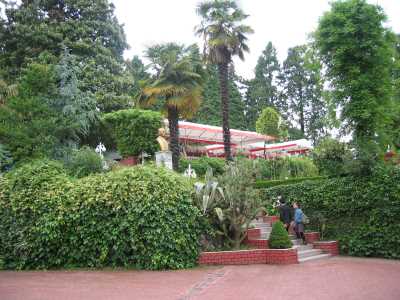
Seating and steps among the trees at Ziraat Botanical Tea Garden in Rize; an archival Turkish Culture Portal photograph.
Rize’s tea travels from planted hillsides to leaf-buying stations, processing and packing facilities, then on to café glasses and gift shops. Start by choosing the experience you want: working production, agricultural research and miniature processing, a break at Ziraat Garden, or tasting and shopping at the Tea Bazaar. Each has its own location and arrangements.
1.  How Rize’s Tea Industry Began
Official records date the first dry tea made from the local harvest to 1938. Turkey’s first tea factory opened in Rize in 1947 as Merkez Çay Fabrikası, with a historical capacity of 60 tonnes of fresh leaves per day. This marked the move from experiments and workshops to industrial processing. That figure describes its capacity at opening; it is neither a present-day plant capacity nor evidence that its historic building can be visited.
“The tea factory in Rize” does not identify a single destination. The province has production plants, research facilities, interpretation spaces, gardens and retail attractions. This guide explains the manufacturing process and helps you choose the organisation suited to what you want to see.
2.  Which “Tea Factory” Do You Mean?
| Place | Purpose | What to arrange |
|---|---|---|
| ÇAYKUR production factories | Making dry tea; examples include Zihniderin in Rize and Melyat in Pazar | Request the facility’s permission; a working factory does not automatically offer public tours |
| ÇAYMER, Rize Tea Research and Application Centre | Research, training, analysis, pilot production and packing in Çayeli district | Ask whether visitors can be received; no public tour programme is confirmed |
| Atatürk Tea and Horticultural Research Institute | Agricultural and technical research, including miniature black- and green-tea facilities | Ask about an educational experience for your date |
| Ziraat Botanical Tea Garden | Plants, views and a tea break | Check garden services and café hours |
| Çay Çarşısı, the Tea Bazaar | Tasting, shopping, the Tea Glass Tower and interpretation | Confirm shop, terrace and cinema hours and individual charges |
ÇAYMER supports the tea sector through research and practical services. Its institutional description lists a pilot production line, packing and laboratories. It is distinct from ÇAYKUR’s Atatürk Institute and Ziraat Garden in central Rize. A pilot line does not establish a museum or daily tourist tour; ask what activity is actually available before choosing the destination.
ÇAYKUR’s institute description places the botanical park and Ziraat Tea Garden under its responsibility and identifies miniature black- and green-tea facilities used for research. An official report also documents a group watching miniature-factory processing after harvesting at Ziraat. This establishes a past educational experience; confirm whether it can be arranged for individuals or families before planning around it.
3. Arranging a Factory or Processing Visit
Identify the Turkish name and location, then contact the organisation directly. For an educational experience, the Atatürk Institute’s contact page lists [email protected] and +90 464 213 02 11. Its administrative address is Hayrat Mahallesi, 2 Nolu Ziraat Sokak No:62, Rize. Request the precise meeting point, which may differ from the public garden entrance.
For ÇAYMER, the website lists [email protected] and +90 537 363 50 60. Its current contact details give Şirinköy Köyü, Çayeli/Rize, while other institutional material uses Musadağı. Request the current map location and meeting point before travelling. Ask specifically about observing the pilot line or an educational demonstration, individual or group access, and available languages.
For a production facility, the official page for Zihniderin Tea Factory in Rize’s Fener neighbourhood lists [email protected] and +90 464 223 42 74. Melyat Tea Factory, in Merdivanlı village, Pazar district, lists [email protected] and +90 464 625 70 09. These are examples of production facilities; entering either requires clear permission from its management.
Give alternative dates, group size, children’s ages and your preferred language. Ask whether the visit includes a working production line, a miniature demonstration or an explanation only. Confirm duration, charges, photography rules and wheelchair access. Keep the confirmation and meeting point, and reconfirm before travelling. Follow staff instructions and any protective-clothing requirements.
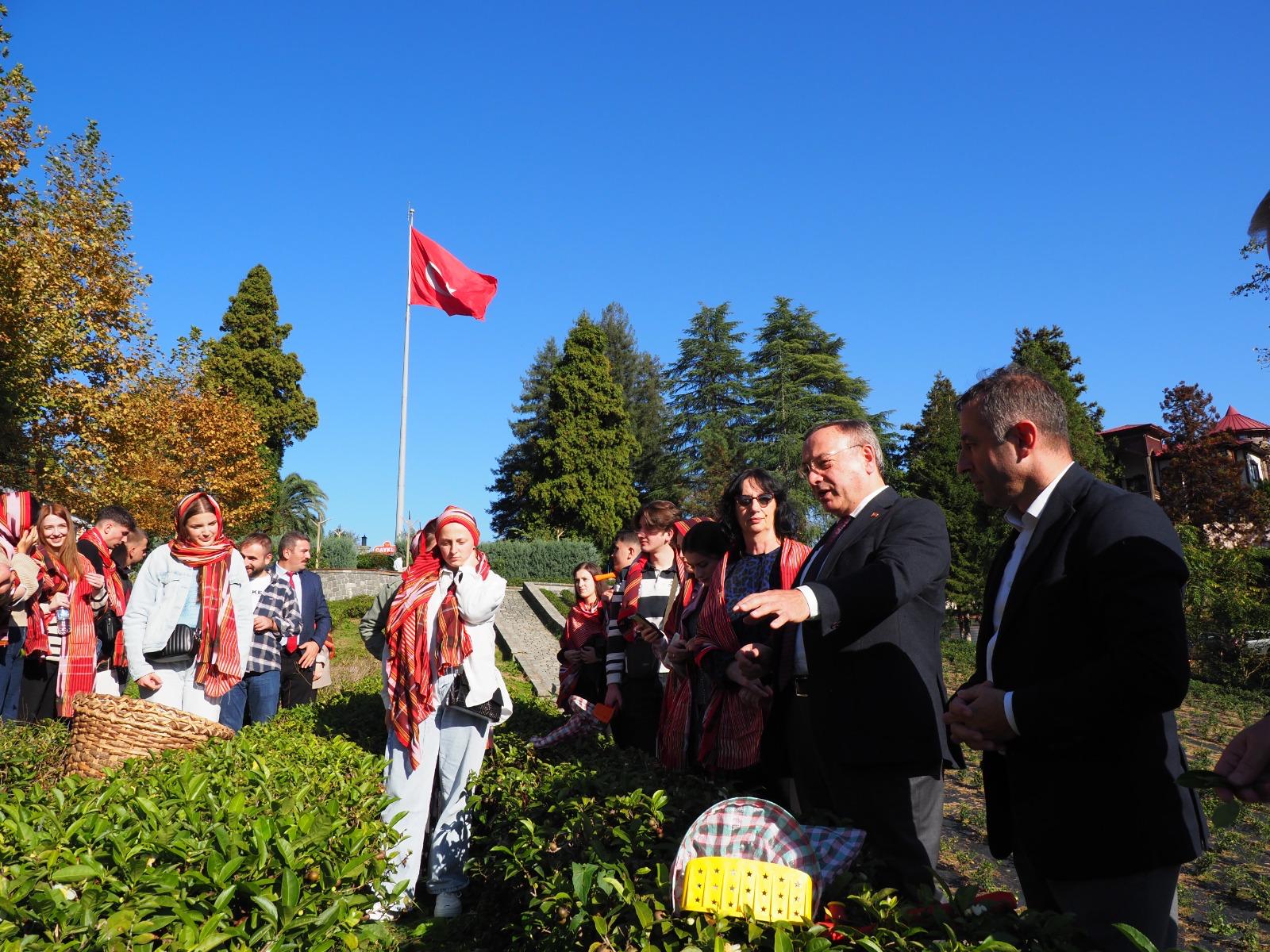
A group among tea bushes during an educational visit documented by ÇAYKUR; this photograph shows neither a production line nor a daily tour.
4.  From Fresh Leaf to Black Tea
Fresh leaves and dry tea are different stages of the product. After reception, black-tea manufacture follows these main operations; equipment and supporting processes can vary between facilities.
| Stage | What happens? | What to look for in an explanation |
|---|---|---|
| Reception and preparation | Leaves are weighed and prepared | Leaf condition and movement to the production line |
| Withering, Soldurma | Moisture falls and leaves become flexible | Withering troughs and airflow |
| Rolling, Kıvırma | Cells break and juices are released | Rolling machinery and changes in leaf texture |
| Oxidation, Oksidasyon | Enzymes and oxygen develop colour and aroma | Green leaves turning coppery |
| Drying, Kurutma | Heat stops oxidation and reduces moisture | Dry tea leaving the dryer |
| Sorting and packing | Grades are separated and prepared for sale | Particle sizes and packaging |
Orthodox rolling and CTC: Orthodox processing rolls the withered leaves. CTC passes them through rotating cylinders that crush, tear and curl them into smaller particles, followed by oxidation and drying. These terms do not define fixed quality grades or establish the method used by the plant you plan to visit. Ask which system its line uses; technical references also describe combinations of rolling machines, Rotorvane equipment and CTC.
Why does the process continue after drying? Tea is sorted into particle-size grades, and batches or grades may be blended to meet product specifications before packing. Seeing leaves on a conveyor is different from seeing final packaging, so agree which part of the chain the visit covers. During the explanation, ask how moisture, processing time and product consistency are monitored instead of assuming that every visible machine performs the same task.
You may hear this oxidation stage described as “fermentation”; in black-tea processing it refers to enzymatic oxidation. Ask the guide to explain how green-tea manufacture differs. A company’s product range does not mean every production line is operating or accessible on your visit.
5.  Harvest Season and Working Production
ÇAYKUR’s 2026 announcements record the start of first-flush leaf purchasing on 20 May, the second flush on 8 July, while the third was announced to begin on 1 September. These dates belong to the 2026 season; future years depend on plant growth, conditions and official announcements.
If fresh leaves and a working processing line are your priority, coordinate your visit request with leaf purchasing and confirmation that the facility will be operating that day. Tea breaks and shopping follow a separate schedule. A photograph of a green tea field does not establish that tourist harvesting is available: arrange any participation with the owner or organiser beforehand.
6.  Ziraat Garden: Tea and the View
Ziraat combines labelled plants, views across Rize, the castle and the sea, and a family café. It is reached by a steep climb: the provincial tourism directorate estimates a 20–30-minute walk from the centre, depending on route and ability. Ask about current services from the PTT area or use a taxi if the climb is difficult.
Plan the garden as a separate break and ask about any booked educational activity. Visiting its café does not automatically include the institute’s laboratories or miniature processing facilities.
7.  The Tea Bazaar and Tea Glass Tower
Çay Çarşısı is on Menderes Boulevard in Rize’s central Eminettin neighbourhood. It brings together tea shops, tasting spaces and services, with Bardak Kule, the Tea Glass Tower, as its landmark. The provincial tourism directorate describes a cinema experience about tea’s journey and a panoramic terrace inside; confirm that both will be operating when you visit.
The bazaar’s own website lists +90 464 211 50 50 and [email protected]. Its address is Eminettin Mahallesi, Menderes Bulvarı No:57/1A, İç Kapı No:1, Merkez/Rize.
Ask separately about bazaar, terrace and cinema hours, screening times and language, and individual admission or service charges. Avoid relying on an old quoted price or assuming that a tea purchase includes tower admission. If a museum is central to your plans, confirm the exhibition’s name, location and current access with management: a museum development plan alone does not establish that it is open.

Rize Tea Bazaar and its illuminated Tea Glass Tower at night; photograph from the official Rizedesin guide.
8.  Tasting and Buying Tea
Ask to taste a local black tea before choosing a pack, and enquire about available green teas, blends or gift selections. If you wish, compare them without sugar first and note the exact product name rather than relying on the packaging colour.
Check the weight, price, product name and origin and production details; read the label when looking for organic tea. Choose a securely sealed pack for your luggage and keep it away from moisture and strong smells. The company also sells through the official ÇAYKUR shop linked from its website, which can help you compare product names before shopping.
9.  A Practical Rize Itinerary
With a confirmed processing visit: Start with the institute or factory appointment at the time agreed by management. Fit a Ziraat break and bazaar tasting and shopping around it. Leave enough travel time: factories in outlying districts are not necessarily close to the central attractions.
Without a processing appointment: Begin at Ziraat when the weather allows, then return to the centre for lunch and the Tea Bazaar. Add the terrace or cinema once access is confirmed, and combine the day with Rize Castle or the city museum if time permits. This still offers a useful introduction to tea culture and tasting without depending on factory admission.
For families, arrange the climb and return from the garden, and ask about lift and terrace access before booking a tower activity. Rain can make paths slippery and limit views; keep shopping and interpretation as flexible alternatives and follow instructions at each place.
 Related topics
 - Rize 2026: Tea, Castle, Museum and Gardens
- Fırtına Valley and Ardeşen 2026: River, Bridges, Villages and Heritage
- Çamlıhemşin, Zilkale and Palovit 2026: Villages, Castle and Waterfall
- Ayder 2026: Pastures, Forests, Waterfalls and Thermal Springs
- Pokut and Sal 2026: Pastures, Wooden Houses and Highland Landscapes
- Kaçkar and Yukarı Kavron 2026: Peaks, Lakes, Forests and Pastures
- İkizdere and Anzer 2026: Valleys, Villages, Pastures and Honey Heritage
- Fındıklı and Pazar 2026: Coast, Historic Houses and Tea Villages