

- Joined
- Feb 23, 2026
- Messages
- 207
- Reaction score
- 0
- Points
- 16
 Understanding Presidential and Parliamentary Elections and Results in Türkiye: A Guide for 2026
On election night, a news screen may show a leading presidential candidate, a party’s percentage, an alliance’s seats and voter turnout. Although displayed together, these figures answer different questions. The presidency is awarded to a person under a majority rule; parliamentary elections allocate seats among lists and candidates in constituencies. Turnout measures participation, while final results require the official process of records and challenges. Understanding these distinctions makes election coverage easier to assess without turning every new number into a political or legal conclusion.
This explanation was prepared for review in 2026; it does not announce presidential and parliamentary general elections scheduled for this year. Article 77 of the Constitution provides for a joint five-year electoral cycle, with provision for renewing elections under the Constitution. Official bodies determine polling dates, the calendar and implementation details. The examples below use hypothetical figures and names for learning. They are not a poll, forecast or actual results for 2026, and recommend no party or candidate.
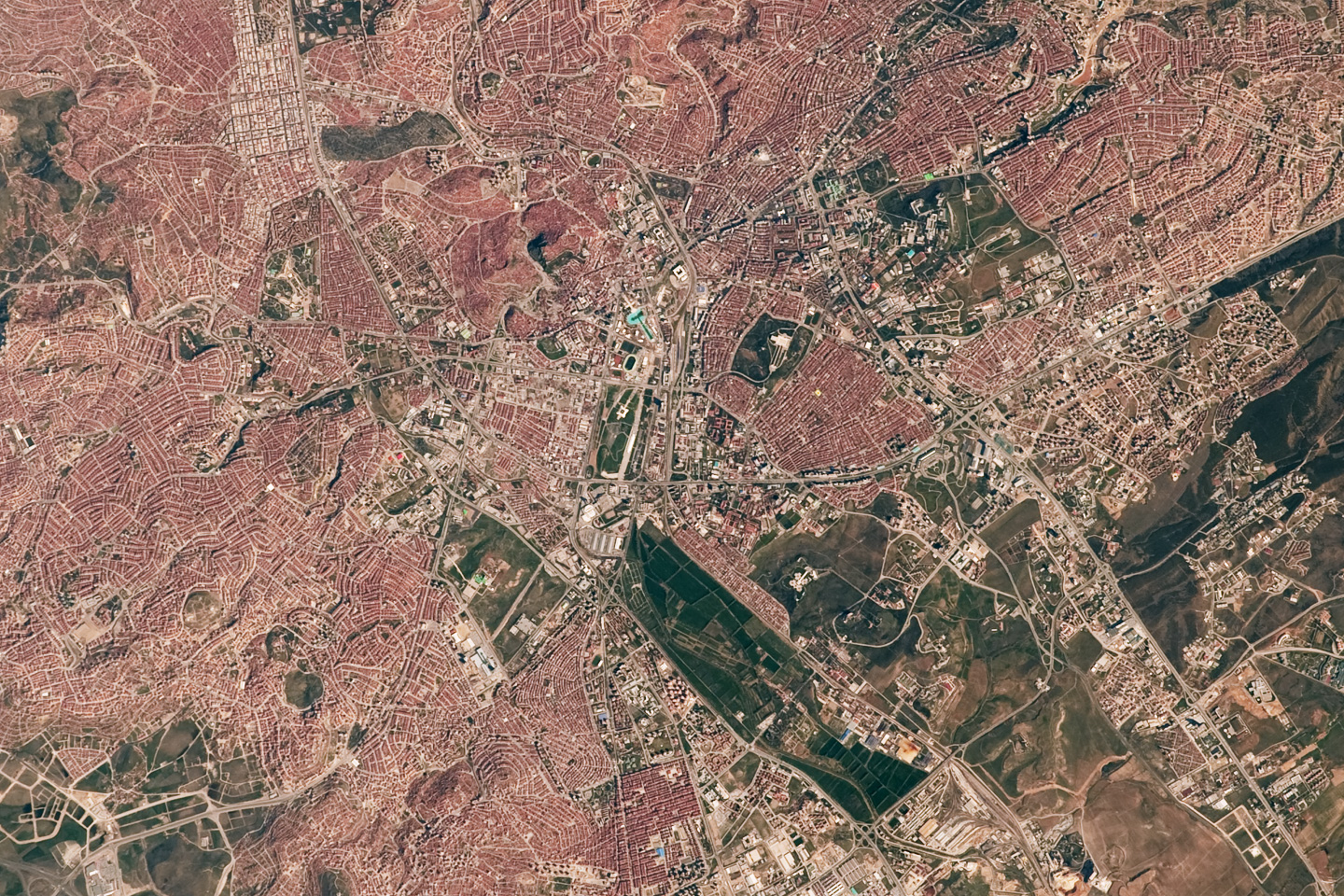
Archive photograph of Ankara taken from the International Space Station on 11 April 2009; this general view of the capital does not represent its urban development in 2026.
Two ballots mean two different choicesIn joint elections, voters choose a president and parliamentary representation, but each ballot has its own rules and results. A presidential candidate may attract support from people choosing different parliamentary lists. A party may back a presidential candidate without the candidate’s votes becoming votes for that party when seats are calculated. Do not combine presidential and parliamentary percentages into one figure or infer that a winning candidate’s political list automatically received the same share.
When comparing two tables, check their headings: Cumhurbaşkanı Seçimi identifies the presidential election, and Milletvekili Genel Seçimi the parliamentary general election. Then read the year, round and geographical scope. One published table might cover the whole country and the other a local area; either may use partial votes rather than the final total. If a post omits those details, describe its figures as insufficiently identified without accusing its author of a particular intention. Accuracy begins with establishing what a number measures before interpreting it.
 How does a presidential candidate win?
Article 101 of the Constitution sets an absolute-majority rule for valid votes in the presidential ballot. The relevant base is valid votes, rather than the population or everyone on the electoral register. If no candidate achieves the required majority in the first ballot, a further round takes place between the leading candidates under the constitutional and legal rules. Do not apply mayoral-election or parliamentary-seat rules to the presidency, or treat first place alone as proof that the contest has ended in the first round.
For illustration, suppose there are 1,000 valid votes in a hypothetical election. Exactly 500 votes are half, rather than more than half; 501 exceed half. This arithmetic example explains a majority without determining a real constituency’s result or a candidate’s eligibility. Read unrounded figures when the margin is small: a shortened percentage on screen may conceal fractions relevant to the calculation, whereas official results rely on approved numbers and records.
 A presidential run-off does not mean re-electing parliament
A second presidential round can take place without repeating the parliamentary vote. The absence of a new seats table in run-off coverage therefore does not mean parliamentary results are incomplete. The second round settles the presidential choice under its conditions, while parliamentary results follow a separate process. A historical archive may give one date for the joint poll and a later date for the presidential run-off; match each date to the correct event before comparing them.
Nor can electoral behaviour between rounds be inferred simply by subtracting aggregate figures. Turnout, invalid votes and the composition of those who voted in the first round may change. You can describe a change in national totals, but those totals do not reveal each individual’s choice. It is mistaken to say that every supporter of one candidate switched to another merely because two numbers are similar. Such an inference requires different data and a suitable method; where supported, present it as a possible interpretation rather than an established fact.
 Parliamentary seats are not a direct national percentage
The Constitution provides for 600 members of parliament. The Parliamentary Elections Law sets out proportional representation and constituency seat allocation. Do not translate a national percentage directly into the same proportion of seats in every constituency, or assume a party with a tenth of the votes must receive a tenth of all seats. Constituency seat totals, votes within each constituency and rules on participation, the threshold, alliances and independent candidates all affect the calculation that produces the national seat total.
Imagine one party whose votes are spread evenly across many constituencies and another with a similar national total concentrated in particular constituencies. Similar national vote shares need not produce identical seat totals. This explains why constituency data matter; it does not establish that a particular arrangement is fair or unfair. To investigate a difference between votes and seats, begin with the applicable rules, boundaries and actual figures, then separate the arithmetic explanation from the political assessment on which opinions may differ.
 A simplified example of successive division
To understand the calculation known as the d’Hondt method, imagine a five-seat constituency with three lists eligible for allocation. List A receives 10,000 votes, B receives 6,000 and C receives 4,000. Divide each list’s votes by one, two, three and so on, then select the highest quotients until all available seats are allocated. This is not a real Turkish province. It leaves aside independent candidates, the threshold and special provisions to explain the basic principle alone.
The five highest quotients in this example are 10,000 for A, 6,000 for B, 5,000 for A, 4,000 for C and approximately 3,333 for A. The illustrative outcome is three seats for A and one each for B and C. Percentages alone do not allow fractional seats to be distributed intuitively: a seat is a whole unit. Ties in an actual calculation must be resolved under the law and official procedure, rather than the reader’s personal choice.

Archive photograph of the Turkish Constitutional Court building from October 2020; it does not document a judgment or hearing in 2026.
 Thresholds and alliances: check the applicable rules
Law 7393 amended the national threshold in the Parliamentary Elections Law to 7% in 2022 and changed how alliance members are treated in seat calculations. That date helps explain why older accounts may differ from the amended rule. Do not transfer an example published before the amendment to a later election without checking the law applicable to it. Nor does an alliance mean all its parties’ votes become a single list for constituency seat allocation.
The amended text distinguishes an alliance’s qualification under the threshold from calculating its parties’ seats using each party’s constituency votes. Interpreting an actual case nevertheless requires that election’s data and classifications, including common alliance votes, candidates and accepted lists. A simple calculator cannot provide a complete legal determination if it leaves out necessary inputs. Use it to understand the division method, then consult the official result and law when interpreting a particular seat. Do not change a rule or percentage on the strength of a post reporting a proposed amendment whose entry into force has not been established.
 Valid votes, turnout and counting progress
Turnout compares the number who voted with the relevant registered electorate. A candidate’s or party’s share relates to valid votes in the ballot concerned. The percentage of ballot boxes counted measures data-collection progress, rather than turnout or support. Most boxes might have been counted without representing the same proportion of voters: boxes need not have equal electorates, and the order in which areas report affects the running total.
In an educational example, 800 of 1,000 registered voters might vote, with 780 valid votes in one of the two elections. Turnout uses the 800 who participated, while the candidate’s share uses the 780 valid votes. Do not use the same denominator for both. When comparing the presidential and parliamentary ballots in joint elections, check each ballot’s valid-vote total separately. The validity of one paper does not automatically determine the validity of the other in the same envelope.
 Votes cast abroad and geographical totals
Citizens’ votes cast outside the country form part of national election arrangements. Displaying them in separate media tables does not make them a separate election choosing another parliament. If a map shows votes in a foreign country, establish whether it concerns voters registered there, the location where votes were collected or another classification. Do not infer the whole diaspora’s views from those who participated, or treat votes at a particular location as a census of Turkish residents in that country.
When comparing figures, adding an overseas table to a national total that already includes those votes counts them twice. Read the document’s definition of geographical scope before adding numbers, and give each file a field explaining what it includes. If inclusion remains unclear, present the original figures with their stated scope rather than creating a new total. Accurate geographical boundaries matter as much as accurate addition, especially when comparing a historical election with a more recent presentation.
 Media figures and official results
A media organisation may compile rapid returns while official results proceed through ballot-box records, aggregation by electoral bodies and determination of challenges. Read how a figure is described: partial, provisional or announced by an official decision. A “breaking” headline does not change its legal status, and reporting a high proportion of ballot boxes does not remove the need for the remaining records. When sharing coverage, include its update time, scope and the body supplying the figure so readers can assess comparisons in context.
Article 79 of the Constitution sets out the Supreme Election Council’s (YSK) responsibilities for administering, supervising and determining electoral matters within its competence. An official document therefore matters when confirming final results. A television screenshot is not equivalent to a published decision, and a counting form from one ballot box is not a national record. If two figures differ, first check the year, round, election type, time and aggregation level. Their scopes may differ before any question of a reporting error arises.
 Reading reports about a majority of seats
A report may give a vote share, name the largest party and state an alliance’s seat total. These facts are connected but do not describe the same thing. “Largest party” ranks parties; a seat majority requires comparing a number with the relevant total; and an alliance describes political cooperation whose details need defining. Do not assume a presidential percentage grants a parliamentary majority or that the national leading party leads in every constituency. Put the figures in separate sentences, then explain only the relationship the source supports.
Also distinguish seats awarded at a historical election from parliament’s composition at a later date. Affiliations may change, seats may become vacant and other procedures may intervene. An old election-results list does not automatically describe parliament in October 2026. A report about the current position needs a dated parliamentary reference. This guide explains reading and calculation, rather than supplying officeholders’ names or forecasts of future seats simply to fill it with details that may change.
 Checks before sharing figures
- Identify the election type, year and round, and whether the figure is national, local or concerns votes cast abroad.
- Separate turnout, shares of valid votes and the proportion of ballot boxes counted.
- Distinguish votes from seats; do not convert a national percentage directly into a parliamentary distribution.
- Check the applicable law and its date when using an explanation of thresholds, alliances and allocation.
- Give the result’s update time and status, and consult official documentation when confirming the final result.
- Clearly label hypothetical examples; do not present a teaching calculation as news about 2026.
 Frequently asked questions
Does receiving the most votes always settle the presidential first round?
The candidate must achieve the required majority of valid votes under presidential-election rules. First place among the candidates is not enough on its own.
Are parliamentary elections automatically repeated with a presidential run-off?
Keep the two presidential rounds separate from the parliamentary election. Check which ballot the round’s announcement and results table concern.
Why can vote and seat shares differ?
Seats are allocated within constituencies under the law and its calculation method. Their total is affected by the distribution of votes, the threshold and lists, rather than simply multiplying the national vote share by the number of seats.
Does every change in a partial result indicate an error?
Check the arrival order of records, data scope and update time. Changes during aggregation need explanation through the documents; they do not alone establish an irregularity.
Does this article predict the next election’s outcome?
Its figures are educational, and it is a guide for understanding the system in 2026. It supplies no unannounced date, endorses no party or candidate and forecasts no seat distribution.
 Related topics
 Following Public Affairs and Government Decisions in Türkiye
 How Laws and Official Decisions Are Made in Türkiye: A Guide for Residents and Visitors
 Türkiye’s Official Gazette: How to Find Laws and Government Decisions
 Laws, Presidential Decisions and Local Rules in Türkiye: Who Has the Power to Act?
 Municipalities in Türkiye in 2026: Responsibilities, Services and Getting Procedures Right
 Municipal Elections and Local Government in Türkiye: A 2026 Guide
 Municipality or CİMER? Choosing the Right Complaint Route in Türkiye in 2026
 Organising and Storing Important Documents in Türkiye
 Türkiye Public Affairs and Politics: Guide Index 2026
Last edited by a moderator: