عناقيد
Active member
- Joined
- Oct 19, 2025
- Messages
- 116
- Reaction score
- 0
- Points
- 16
Turkey’s Social Security Institution, SGK, issued two separate changes to its medicine reimbursement lists in October 2026: notice 2026/40 dated 14 October and the announcement of two medicine reimbursement committees’ decisions published on 16 October. The details matter to people with SGK cover who need to match a prescription or a particular pack against the list. They do not mean that every product is free or that every foreign resident automatically qualifies.
This explanation sets out the changes in the original annexes as reviewed on 20 October 2026, separating publication from commencement and distinguishing a product addition from an amendment, inactivation or removal. The names and codes below identify the correct records; they are not recommendations for treatment or medicine substitution.
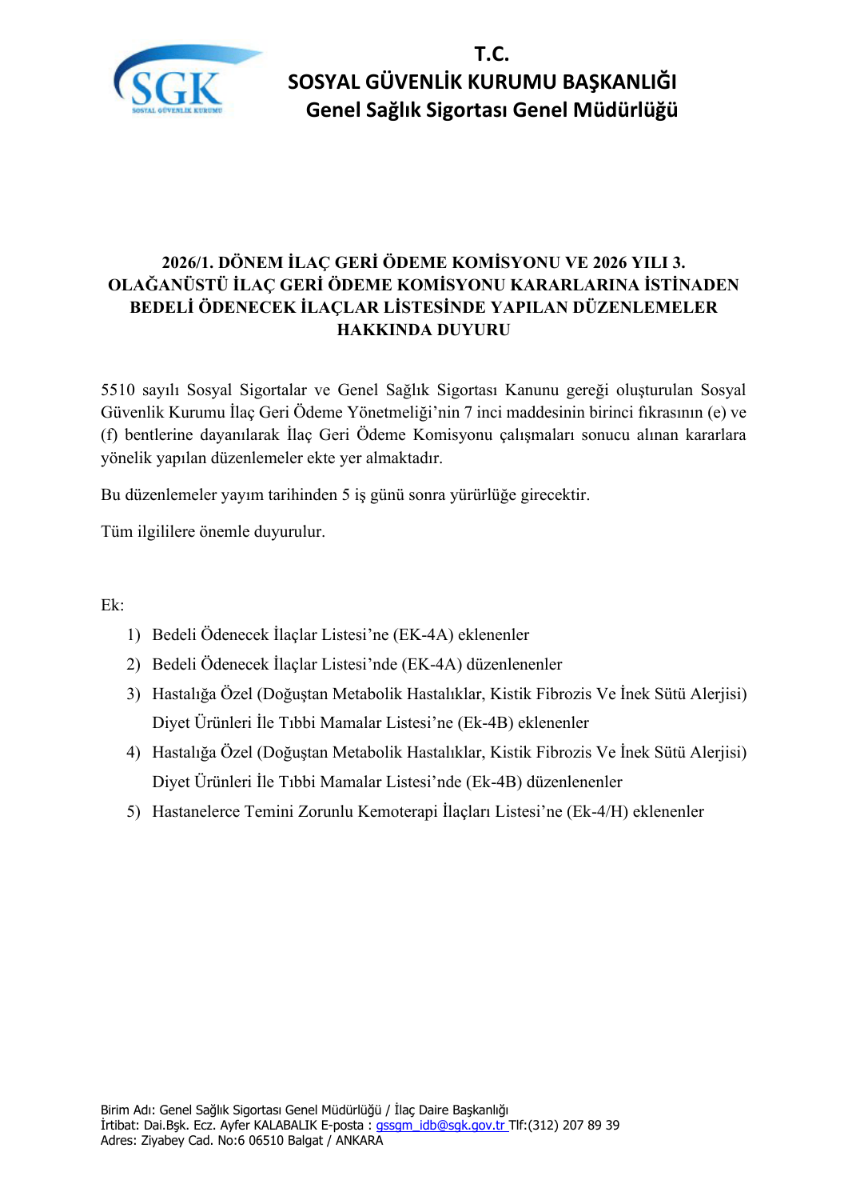
The cover of the committee-decisions announcement published on 16 October lists five annexes and specifies commencement five working days after publication. It does not display every product name.
 Two notices with different commencement rules
Open the original notice 2026/40 for its commencement clause, and use the committee-decisions announcement page for the separate files. In the second announcement, 16 October is the publication date; the first notice’s commencement date must not be transferred to it. Nor do we turn “five working days” into a guessed calendar date.
A date found in an Excel record does not by itself establish commencement for the entire change. Columns cover list entry, activation, inactivation, commencement of band tracking and the final deadline for a distribution certificate. A record can retain an earlier date belonging to the product. Read the column heading before interpreting the value.
 What changed under 2026/40?
The Excel annex to notice 2026/40 contains four types of change across 18 actual data rows. The count excludes headings and the blank row. It does not mean that 18 new medicines were added.
The three actual additions appear below, keeping the commercial names exactly as written in the source to make matching easier. The Kamu No public code is distinct from the pack barcode. Strength, dosage form and pack also matter.
All three records show a list-entry date of 16 October 2026. The excerpt below displays only their names and identifiers. It is not a price table or evidence that a particular patient can obtain them.
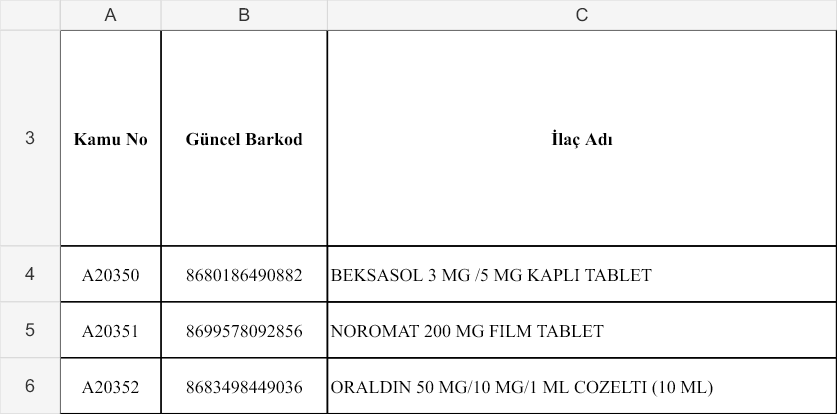
Source excerpt from sheet “4A EKLENENLER”, cells A3:C6: the three additions in 2026/40, with the original cells unchanged.
Examples from the other categories include ASIPEC 1 MG 30 TABLET, public code A09485, under inactivation, with a recorded inactivation date of 16 October. The removal sheet lists ENSURE CILEK 250 ML SOL, A02727, and GLUCERNA SR CILEK AROMALI 230 ML SOL, A03438. Both retain an earlier inactivation date of 12 December 2025. That is not commencement of the new change. Removal from a reimbursement list does not itself announce withdrawal from the market or a prescribing ban.
Amendment examples include BEKUNIS, KONAZOL and some LUNIVEX packs. The sheet label alone does not identify which cell changed compared with the previous version. A price reduction or expanded indication therefore cannot be inferred without a separate comparison.
 The 16 October announcement: medicines, medical nutrition and hospital supplies
The second update implements decisions of the first regular Medicine Reimbursement Committee cycle of 2026 and the year’s third extraordinary committee. Its original workbook has five sheets, separate from the 2026/40 file. The announcement cover explains the annexes and commencement rule; product names and details are in the workbook.
The A and B addition sheets together contain 131 rows. These are product or pack records, not 131 distinct active ingredients or separate treatments. The four H records must not be added to this figure to produce a new-medicine total: product identities can overlap between A and H, and the lists perform different reimbursement and supply functions.
For example, EK-4/A contains BECEFIST 600 MG FILM KAPLI TABLET in two packs: 10 tablets under public code A20358 and barcode 8680150090063, and 14 tablets under A20359 and barcode 8680150090339. Counting two rows is correct; calling them two new active ingredients is not. The sheet’s first product is ABITIGA 500 MG FILM KAPLI TABLET (60 ADET), public code A20353, barcode 8685025090087.
In EK-4/B, the additions are PKU COOLER 15 SARI (30x130 ML), A20482, and RENASTEP 24X125 ML, A20483. The annex title concerns disease-specific dietary products and medical nutrition, naming conditions including congenital metabolic diseases, cystic fibrosis and cow’s milk allergy. A product’s presence here does not make it appropriate for every patient with one of those conditions. Its use and reimbursement depend on the individual situation and applicable rules.
EK-4/H includes, as examples identifying its records, PEMCURE in 100 MG and 500 MG strengths, codes A20429 and A20430, alongside MYELOVEX and TERUVİA. The list title concerns procurement by hospitals. It does not promise immediate stock in every pharmacy or authorise obtaining chemotherapy independently of the treating team.
 Asterisks and 20 November: read the column first
Some cells in the committee workbook contain the literal markers * and *+5, including list-entry or distribution-certificate-deadline fields. Neither the cover nor the definition areas examined supplied a verified explanation. They are retained as written: we do not assume that an asterisk means publication day or that the five in the marker means five calendar days.
A date of 20 November 2026 appears for METLINOX 69,19 MG/ML ORAL DAMLA, SUSPANSIYON (30 ML), code A20303, in the final deadline for submitting a distribution certificate. It belongs to that record and purpose. It is not the start of reimbursement for all products or a closing date for patients’ applications. The same record retains an earlier list-entry date of 20 June 2026. This illustrates why the entire file cannot be summarised by its latest visible date.
If your medicine appears among the amendments, match the public code, barcode and pack first. A similar name is insufficient. Do not apply another product’s date or strength to the prescription’s record.
 Did the medicine’s price change, and what might the patient pay?
The annexes do not provide a final pharmacy selling price for every pack. Headings such as “sale price to the wholesaler” divide products into bands for discount calculations. Values such as 0.28 or 0.18 are rates linked to the category. They are not the pack price or a ready-made personal reimbursement percentage. No bill or assumed cash saving is calculated from them.
SGK’s medicine co-payment page describes a 10% share for recipients of SGK income or pensions and their dependants, and 20% for others, for outpatient medicines, with report-backed EK-4/D exceptions. This is not an announcement of a new October increase. Having a chronic condition alone does not establish a blanket exemption.
The official price-difference explanation distinguishes the reference price used for reimbursement from a possible patient-paid difference. Not every reference-group product can be substituted at a pharmacy. Ask the pharmacist about an interchangeable equivalent without a difference, where available, rather than changing treatment yourself.
Your final amount therefore remains undetermined by this report. It depends on the pack, insurance position, prescription, report and exceptions; the amount requested can also contain other separate items. Ask for a breakdown of the co-payment, price difference and any other charge rather than assuming that the total is solely the medicine’s price.
 How to check what applies to you
Start with the SPAS health-entitlement enquiry in e-Devlet to review your social-security entitlement, then consult the doctor or contracted pharmacy appropriate to your situation. General entitlement does not by itself prove that every product or dose on a prescription meets reimbursement rules. A private policy purchased for residence purposes is also not automatically equivalent to SGK cover.
If you are told that the product is inactive or removed, ask the pharmacist or doctor to identify the record, list and reason affecting the prescription. Do not stop continuing treatment or change strength or pack because of a news headline. The information here helps you ask the right questions and avoid confusing the lists. It does not replace clinical assessment or the actual reimbursement decision.
Three points still require confirmation when the product is needed: the pack’s final price, the patient’s and prescription’s compliance with the conditions, and the meaning of any marker left undefined in the source. The report establishes the described list changes and records, not approval of an individual claim or free dispensing for every foreign resident.
 Related topics
This explanation sets out the changes in the original annexes as reviewed on 20 October 2026, separating publication from commencement and distinguishing a product addition from an amendment, inactivation or removal. The names and codes below identify the correct records; they are not recommendations for treatment or medicine substitution.
The cover of the committee-decisions announcement published on 16 October lists five annexes and specifies commencement five working days after publication. It does not display every product name.
Two notices with different commencement rules| Notice | Scope | Verified commencement |
|---|---|---|
| 2026/40 — 14 October | Four categories of changes to EK-4/A | 16 October 2026 |
| Committee decisions — published 16 October | Changes to EK-4/A and EK-4/B, plus additions to EK-4/H | Five working days after publication, as stated in the notice |
Open the original notice 2026/40 for its commencement clause, and use the committee-decisions announcement page for the separate files. In the second announcement, 16 October is the publication date; the first notice’s commencement date must not be transferred to it. Nor do we turn “five working days” into a guessed calendar date.
A date found in an Excel record does not by itself establish commencement for the entire change. Columns cover list entry, activation, inactivation, commencement of band tracking and the final deadline for a distribution certificate. A record can retain an earlier date belonging to the product. Read the column heading before interpreting the value.
What changed under 2026/40?The Excel annex to notice 2026/40 contains four types of change across 18 actual data rows. The count excludes headings and the blank row. It does not mean that 18 new medicines were added.
| Change category | Data rows | How to read it |
|---|---|---|
| Addition — EKLENENLER | 3 | Three products entered EK-4/A |
| Amendment — DÜZENLENENLER | 12 | Changes to listed product records, not twelve additions |
| Inactivation — PASİFLENENLER | 1 | One product placed in the list’s inactive category |
| Removal — ÇIKARILAN İLAÇLAR | 2 | Two products removed from the list in this annex |
The three actual additions appear below, keeping the commercial names exactly as written in the source to make matching easier. The Kamu No public code is distinct from the pack barcode. Strength, dosage form and pack also matter.
| Product as listed | Public code | Pack barcode |
|---|---|---|
| BEKSASOL 3 MG /5 MG KAPLI TABLET | A20350 | 8680186490882 |
| NOROMAT 200 MG FILM TABLET | A20351 | 8699578092856 |
| ORALDIN 50 MG/10 MG/1 ML COZELTI (10 ML) | A20352 | 8683498449036 |
All three records show a list-entry date of 16 October 2026. The excerpt below displays only their names and identifiers. It is not a price table or evidence that a particular patient can obtain them.
Source excerpt from sheet “4A EKLENENLER”, cells A3:C6: the three additions in 2026/40, with the original cells unchanged.
Examples from the other categories include ASIPEC 1 MG 30 TABLET, public code A09485, under inactivation, with a recorded inactivation date of 16 October. The removal sheet lists ENSURE CILEK 250 ML SOL, A02727, and GLUCERNA SR CILEK AROMALI 230 ML SOL, A03438. Both retain an earlier inactivation date of 12 December 2025. That is not commencement of the new change. Removal from a reimbursement list does not itself announce withdrawal from the market or a prescribing ban.
Amendment examples include BEKUNIS, KONAZOL and some LUNIVEX packs. The sheet label alone does not identify which cell changed compared with the previous version. A price reduction or expanded indication therefore cannot be inferred without a separate comparison.
The 16 October announcement: medicines, medical nutrition and hospital suppliesThe second update implements decisions of the first regular Medicine Reimbursement Committee cycle of 2026 and the year’s third extraordinary committee. Its original workbook has five sheets, separate from the 2026/40 file. The announcement cover explains the annexes and commencement rule; product names and details are in the workbook.
| List | Action | Product rows |
|---|---|---|
| EK-4/A — medicines whose cost is paid by SGK | Addition | 129 |
| EK-4/A | Amendment | 51 |
| EK-4/B — disease-specific dietary products and medical nutrition | Addition | 2 |
| EK-4/B | Amendment | 1 |
| EK-4/H — chemotherapy medicines hospitals must procure | Addition | 4 |
The A and B addition sheets together contain 131 rows. These are product or pack records, not 131 distinct active ingredients or separate treatments. The four H records must not be added to this figure to produce a new-medicine total: product identities can overlap between A and H, and the lists perform different reimbursement and supply functions.
For example, EK-4/A contains BECEFIST 600 MG FILM KAPLI TABLET in two packs: 10 tablets under public code A20358 and barcode 8680150090063, and 14 tablets under A20359 and barcode 8680150090339. Counting two rows is correct; calling them two new active ingredients is not. The sheet’s first product is ABITIGA 500 MG FILM KAPLI TABLET (60 ADET), public code A20353, barcode 8685025090087.
In EK-4/B, the additions are PKU COOLER 15 SARI (30x130 ML), A20482, and RENASTEP 24X125 ML, A20483. The annex title concerns disease-specific dietary products and medical nutrition, naming conditions including congenital metabolic diseases, cystic fibrosis and cow’s milk allergy. A product’s presence here does not make it appropriate for every patient with one of those conditions. Its use and reimbursement depend on the individual situation and applicable rules.
EK-4/H includes, as examples identifying its records, PEMCURE in 100 MG and 500 MG strengths, codes A20429 and A20430, alongside MYELOVEX and TERUVİA. The list title concerns procurement by hospitals. It does not promise immediate stock in every pharmacy or authorise obtaining chemotherapy independently of the treating team.
Asterisks and 20 November: read the column firstSome cells in the committee workbook contain the literal markers * and *+5, including list-entry or distribution-certificate-deadline fields. Neither the cover nor the definition areas examined supplied a verified explanation. They are retained as written: we do not assume that an asterisk means publication day or that the five in the marker means five calendar days.
A date of 20 November 2026 appears for METLINOX 69,19 MG/ML ORAL DAMLA, SUSPANSIYON (30 ML), code A20303, in the final deadline for submitting a distribution certificate. It belongs to that record and purpose. It is not the start of reimbursement for all products or a closing date for patients’ applications. The same record retains an earlier list-entry date of 20 June 2026. This illustrates why the entire file cannot be summarised by its latest visible date.
If your medicine appears among the amendments, match the public code, barcode and pack first. A similar name is insufficient. Do not apply another product’s date or strength to the prescription’s record.
Did the medicine’s price change, and what might the patient pay?The annexes do not provide a final pharmacy selling price for every pack. Headings such as “sale price to the wholesaler” divide products into bands for discount calculations. Values such as 0.28 or 0.18 are rates linked to the category. They are not the pack price or a ready-made personal reimbursement percentage. No bill or assumed cash saving is calculated from them.
SGK’s medicine co-payment page describes a 10% share for recipients of SGK income or pensions and their dependants, and 20% for others, for outpatient medicines, with report-backed EK-4/D exceptions. This is not an announcement of a new October increase. Having a chronic condition alone does not establish a blanket exemption.
The official price-difference explanation distinguishes the reference price used for reimbursement from a possible patient-paid difference. Not every reference-group product can be substituted at a pharmacy. Ask the pharmacist about an interchangeable equivalent without a difference, where available, rather than changing treatment yourself.
| Item | What does the list establish? | What should be checked when dispensing? |
|---|---|---|
| Pack selling price | No final pharmacy price is established by these annexes | The particular pack’s price on purchase day |
| Patient co-payment | A separate category from inclusion in EK-4/A | Insurance status and the applicable exception |
| Price difference | May exist even for a listed product | Reference price and an equivalent alternative where substitution is permitted |
| Excel discount rates | Used in reimbursement arrangements by band | Do not convert them into a personal payment demand |
Your final amount therefore remains undetermined by this report. It depends on the pack, insurance position, prescription, report and exceptions; the amount requested can also contain other separate items. Ask for a breakdown of the co-payment, price difference and any other charge rather than assuming that the total is solely the medicine’s price.
How to check what applies to youStart with the SPAS health-entitlement enquiry in e-Devlet to review your social-security entitlement, then consult the doctor or contracted pharmacy appropriate to your situation. General entitlement does not by itself prove that every product or dose on a prescription meets reimbursement rules. A private policy purchased for residence purposes is also not automatically equivalent to SGK cover.
- Have the pack name, strength, dosage form and barcode available, together with the prescription number where applicable. Match that product’s record, rather than only an abbreviated name or active ingredient.
- Identify the correct announcement and change category. Separate an addition from an amendment, and an earlier list-entry date from commencement of the current change.
- Ask for the product- and diagnosis-specific SUT conditions to be checked. A report or a prescription meeting particular conditions may be needed. Listing alone does not replace checking dispensing requirements for your case.
- Check the prescription’s validity, any required report, the permitted pack and quantity. A change to a reimbursement list does not itself extend a patient’s prescription.
- Before payment, ask about co-payment, price difference, exemptions and an itemised total. Inclusion does not establish stock availability at every provider.
If you are told that the product is inactive or removed, ask the pharmacist or doctor to identify the record, list and reason affecting the prescription. Do not stop continuing treatment or change strength or pack because of a news headline. The information here helps you ask the right questions and avoid confusing the lists. It does not replace clinical assessment or the actual reimbursement decision.
Three points still require confirmation when the product is needed: the pack’s final price, the patient’s and prescription’s compliance with the conditions, and the meaning of any marker left undefined in the source. The report establishes the described list changes and records, not approval of an individual claim or free dispensing for every foreign resident.
Related topics - Hospitals in Türkiye 2025: Public, Private and University
- Public, Private and University Hospitals in Türkiye 2026
- Booking Medical Appointments through MHRS in Türkiye 2025
- Hospital Appointments in Türkiye 2026: MHRS and Other Providers
- Health Insurance for Foreigners in Türkiye 2025
- SGK Health Insurance for Foreigners in Türkiye 2025
- Residence Health Insurance in Türkiye 2026: Requirements and Cover
- Emergency Care for Foreign Patients in Türkiye 2026
- e-Nabız in Türkiye 2025: Test Results and Medical Records