

سفير طرابزون
Active member
- Joined
- Feb 23, 2026
- Messages
- 207
- Reaction score
- 0
- Points
- 16
 Museum of Anatolian Civilisations and Ankara Castle: A Day of Archaeology and Old-City Streets
Ankara is more than a business stop or a gateway to Cappadocia. Around its castle, you can combine the story of ancient Anatolia with a walk through a neighbourhood where people still live and workshops and cafés still operate. The Museum of Anatolian Civilisations gives small objects their context, while the castle helps you understand the city's location, elevation and walls by seeing them. Together they make a balanced cultural day, provided it does not become a long list of museums and an unbroken uphill climb.
This guide helps you choose galleries, arrive from Ulus and divide your time between indoors and outdoors. The suggested visiting times are planning estimates, rather than compulsory durations or announcements from the museum. Operating information was checked on 8 October 2026; check any ticket or temporary activity again for your travel date.

A replica of the Fasıllar monument in the courtyard of the Museum of Anatolian Civilisations, rather than the original monument at its site.
 How do the museum and castle differ?
The museum has an entrance, a ticket and organised galleries, while the castle is a historic area containing walls, lanes, houses and businesses. Do not expect your museum ticket to admit you to every house or private museum around the castle. Walking between the houses also gives you no permission to climb any staircase or tower that happens to be open. Follow the route permitted by the site's management and the signs on the ground.
Choose the museum first if archaeology interests you or the weather is unsettled. Choose a short outdoor walk around the castle if your group prefers the city and photography to reading labels. A full visit to both needs room for lunch and a rest, rather than just two hours before a train or flight.
| Visit | What does it add? | Suggested time |
|---|---|---|
| Museum of Anatolian Civilisations | The archaeological sequence, craftspeople's skills and writing | Two to three hours |
| Castle lanes | Houses, workshops and the shape of the neighbourhood | An hour with stops |
| A permitted viewpoint | Understanding Ankara's topography and walls | About half an hour |
 The building is part of the collection
The museum occupies two historic Ottoman buildings, Mahmutpaşa Bedesten, a covered market, and Kurşunlu Han, on the edge of the castle area. In the building open to visitors, look at the domes, the changing light and the relationship between the central hall and the passages. Its conversion from a commercial building explains why it feels different from a modern museum with a straight route. Some parts of the han are used for administration and research; being part of the complex does not make every room open to the public.
Before starting, photograph the gallery map if photography is permitted and identify where you will return. If a large school group occupies one section, begin elsewhere and come back. This is a practical way to ease crowding without abandoning the whole chronological sequence or waiting unnecessarily behind a guided group.
 How can you understand the beginnings without tiring yourself out?
The collections begin with early periods and progress towards settlement, villages and more complex societies. You do not need to memorise every period's name to enjoy them. At the stone tools, compare the shape of an edge with the tool's function. At the vessels and small figurines, ask what people needed to store and how the materials they used changed. These are questions prompted by the objects you see, rather than ready-made answers to impose on any artefact.
In the section associated with Çatalhöyük and Hacılar, read the full label of an object you choose instead of hurriedly photographing dozens of cases. Distinguish originals from reconstructions and explanatory models. The first photograph in this guide, for example, shows a replica of the Fasıllar monument in the museum courtyard; it should therefore neither be attributed to the original location nor presented as the original monument itself.
 Trade and writing: a stop worth taking slowly
The Assyrian trading colonies collections show how trade becomes a written record. At the tablets and seals, choose a clear example on display and read its findspot and purpose as explained on the label. A tablet's small size says nothing about its importance. Try connecting the writing system with an everyday problem, such as proving an agreement or recording an exchange, instead of asking only how old the object is.
For children, make the task finding three different materials: stone, clay and metal. Then ask which is easiest to carry and which needs more complex production. Do not ask them to touch the cases or imitate writing on an artefact. A small notebook and pencil are enough for drawing a simplified shape once you have moved out of the visitors' path.
 Hittites, Phrygia and Urartu: choose one comparison
The museum is known for collections that include the Hittites, Phrygia and Urartu. Instead of trying to examine everything in detail, compare a ceremonial vessel, metal decoration and a stone inscription. Read the function given by the museum, then compare the depiction of people and animals and the treatment of the surface. This approach helps you understand differences in craftsmanship and use without merging several civilisations into one description.
If you see an object from Gordion or the Van region, note its site's name. A later visit to that site will mean more when you can connect the exhibit with where it was found. Do not assume every famous object is always available: loans, exhibitions and maintenance can change the displays. Ask staff about the object you came to see before ending your visit, and avoid relying on an old photograph in a travel article.
 The Ankara and Classical galleries: an important partial closure
 When checked on 8 October 2026, the ministry's list recorded the Ankara Gallery and Classical Gallery as closed for maintenance from 14 September 2026, with an estimated reopening on 2 March 2027. This closes two sections; it does not announce the closure of the entire museum. Do not include the lower floor as a guaranteed part of an October itinerary or treat the estimated date as a firm promise.
Ask reception which areas are open and for the current route map before buying any additional service. If Roman Ankara is the main reason for your trip, call ahead to ask whether alternative displays are available in the open galleries. Use the time you would have spent in this section for a closer comparison in the open collections or a longer break before the castle, instead of going through work barriers.
 Tickets and hours after the summer programme ends
When checked on 8 October 2026, the official museum page showed a foreign visitor admission price of €12 and winter hours of 08:30–17:30, with the ticket office closing at 16:45. Plan to arrive in the morning; entering close to the ticket office's closing time leaves too little time for a detailed visit. Turkish citizen admission prices and exemptions for children and students are not a single rule applying to every nationality.
Seasonal notice: The same page advertises a summer night programme running specifically from 1 June to 1 October 2026. Do not apply its evening closing time to an October visit after that date. If management announces a new extension, use that announcement explicitly.Before paying, open the purchase link from the museum page, select the category and number of visitors, and check whether your tourist pass is accepted at this particular museum. Do not buy a pass intended for citizens because its name resembles a foreign visitor pass. Keep proof of exemption eligibility and read the seller's refund terms; this guide makes no promise of free cancellation.
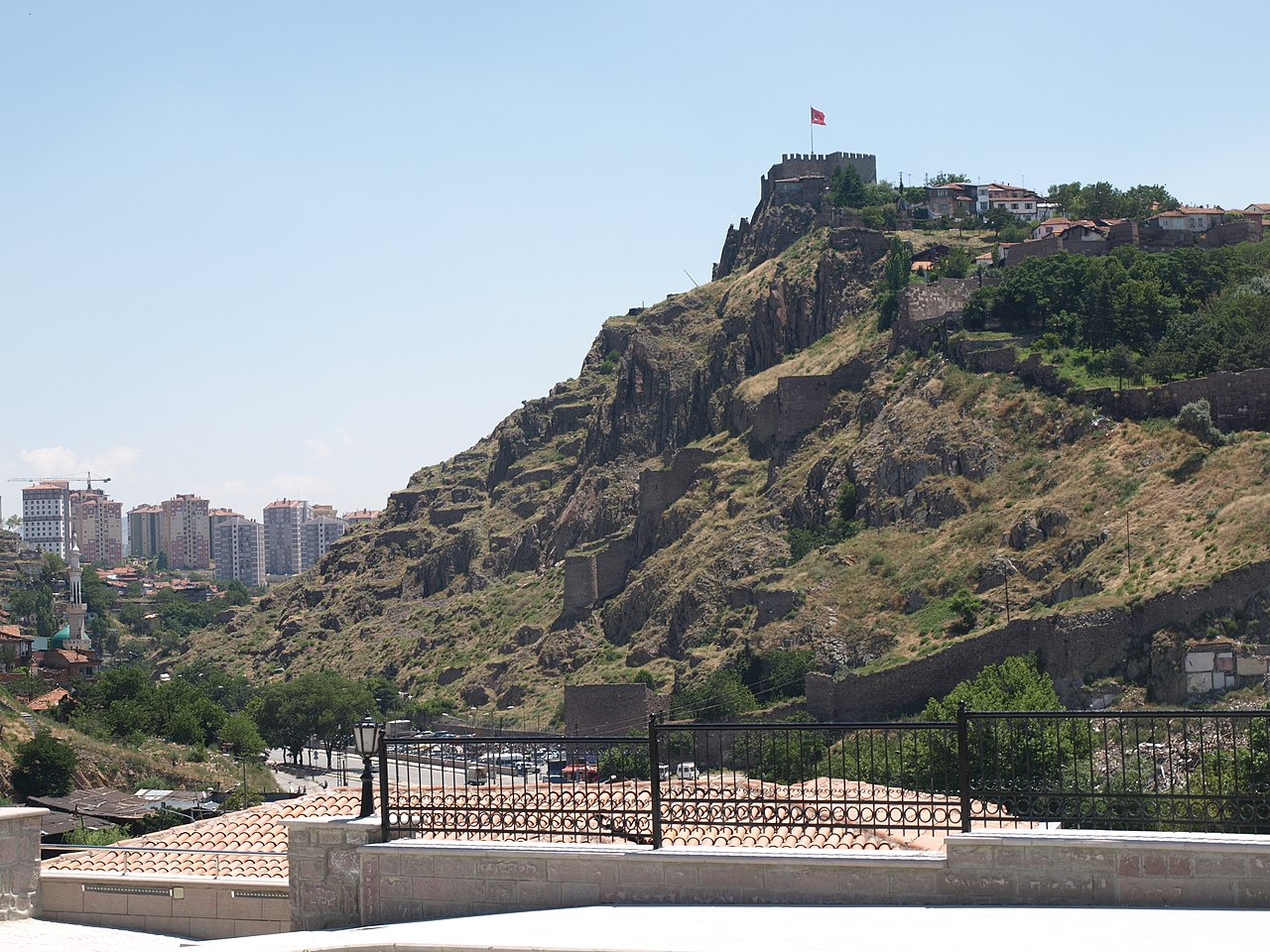
Ankara Castle seen from Hacı Bayram Mosque square, showing its height above the city.
 Arriving from Ulus and the railway station
The museum's official address is on Gözcü Sokak in Ulus, Altındağ. Ulus is a useful public transport arrival point, but the final stretch towards the museum and castle climbs uphill. Check the actual route on a map, rather than its straight-line distance alone. If you arrive at the high-speed railway station, allow extra time to leave the station and reach your vehicle; your tour cannot start the moment the train arrives.
The municipality mentions cultural route 402, which connects places including Ulus and the castle. It is a possible transport option, rather than a guarantee of a guided tour or a bus every few minutes. Check departure times and the appropriate stop in EGO's information on the day of use. For a group avoiding the climb, a taxi to a legal drop-off point closer to the museum may work better, with the return pick-up agreed beforehand.
 The castle: read the walls and give the neighbourhood more than a photograph
The castle consists of inner and outer sections and bears successive phases of construction and repair. Its precise beginnings are not settled in the official account, so avoid giving one date as its definitive foundation. As you walk, look for different wall materials and the way gates connect with the lanes. Do not remove stones or handle loose elements to test their age.
The area contains old Ankara houses, shops and cafés, and is also a place of daily life. Ask permission before photographing inside a shop or taking close-up photographs of people, and do not enter a house courtyard because its gate is open. Keep passages clear for residents and deliveries, and use the cafés for a break that helps you continue exploring at a comfortable pace.
 Restoration and signs: what has changed, and what is still uncertain?
In May 2026, the municipality announced improvements to lighting, signs, safety and parking in the castle area, and mentioned an illustrated map inside it. Use the new signs instead of following a route in an old video. These are important improvements, but they do not make every wall and step easy or accessible to a wheelchair user.
Local works or closed passages may remain even after an earlier restoration project has finished. If you encounter barriers, return to a clearly public street; do not look for a side opening to reach a tower. Do not add the nearby Roman theatre as a guaranteed visit included in the museum ticket: it has separate operating arrangements and an access route that needs checking.
 A route with less exertion for older visitors and families
The museum page lists facilities for visitors with disabilities, but does not explain the suitability of every level for every type of wheelchair. Ask reception about a step-free entrance, the lift or an alternative between sections, and the location of an accessible toilet. Explain your actual needs to staff instead of simply asking whether the place is suitable.
Make the museum the main visit, followed by a short walk in the street near the castle. Reaching the highest viewpoint should not become a test for the rest of the group. With a pushchair, uneven surfaces may matter more than the distance. Split the group if needed: some can visit a permitted viewpoint while others rest at an agreed café, then meet at a clear time and place.
 A realistic day without rushing
1. Morning: Arrive after the museum opens, then allow ten minutes for the ticket, map and confirmation of the open sections. Spend about two hours on the collections that interest you, with a short break if the group needs it.
2. Before midday: Finish the open collections, omitting the closed Ankara and Classical galleries, then move to the castle lanes. The journey between the buildings is no reason to skip lunch; stop somewhere you can properly sit down.
3. After lunch: Allow an hour for the houses, workshops and a permitted viewpoint. If everyone feels comfortable, add a nearby independent museum after checking its ticket and hours. Avoid adding a demanding visit simply because it appears on the map.
4. Return: Allow for the descent and journey to the station, then a clear margin before your train. If you start late, remove the optional extra first and keep the museum and a reliable return plan.
 A budget that reflects the actual cost
For two foreign adults, two museum tickets cost €24 at the stated rate, before any extra service. Add transport, a meal and drinks, then any independent museum you choose around the castle. Do not combine euro and lira prices into one total without stating the exchange rate and its date.
Also compare the cost in time: one vehicle that reduces the group's climb may be better value than a small transport saving followed by early exhaustion. When shopping in the neighbourhood, ask the final price before items are wrapped, and keep gifts separate from essential expenses. Set aside a separate reserve for returning if the weather changes or you miss your chosen bus.
 Rain, cold and photography
In persistent rain, make the galleries your main plan and shorten the castle visit to a safe walk through lanes without steep climbs. Stones and steps may be slippery after rain; a photograph is not worth standing on an edge or beyond a barrier. In hot weather, start early and carry water, drinking inside galleries only where management permits it.
Do not assume flash or tripods are allowed because phones are permitted. Ask before photographing inside the museum and follow each gallery's signs, particularly for temporary exhibitions. Photograph an object's name along with the object where allowed, so you do not return with a large file of photographs whose civilisation or location you cannot identify.
 Questions that simplify your decisions
Are all museum galleries open? No; the Ankara and Classical galleries are listed as closed for maintenance. Check for updates before visiting.
Are two hours enough for the museum and castle? They allow a very selective visit, but a detailed combination with a break needs longer. Choose your priority before arriving.
Is the castle part of the museum ticket? Do not treat the whole area as one package; its private museums and houses have separate conditions.
Does the night programme continue in October? The announcement we checked ends on 1 October. Do not rely on summer closing hours after their stated period without an official extension.
Is it suitable for a child who dislikes reading? Yes, for a short visit with observation tasks, followed by a walk through the lanes and a break. It is unsuitable for insisting that a child read every label.
Do I need a guide? A guide is not required for visiting. A specialist may help if you want a deeper understanding, but check the language, duration, price and whether admission is included.
What should I remove if the weather worsens? Viewpoints and optional climbs first; keep the museum, a clear return arrangement and an indoor break.
 Before you leave
Choose three collections you want to see, check winter hours and the last ticket sale, and select the correct ticket category. Save the museum address, drop-off point and return plan, and ask about access between floors if anyone needs it. Wear comfortable shoes and carry a layer suited to the weather, leaving time for the neighbourhood away from the galleries. These decisions turn the day into a clear story about Anatolia and Ankara, instead of a series of hurried photographs.
 Related topics
- Museums, Palaces and Castles in Türkiye: Regional Highlights and Itinerary Planning
- İstanbul Archaeology Museums: Ancient Civilisations in the Historic City
- Attraction Tickets and Museum Passes in Türkiye: Inclusions and Value
- Planning Attraction Visits with Children and Older Travellers: Comfort, Access and Booking
- Türkiye Attractions and Experiences: Guide Index
- Ephesus from Selçuk: Entrances, Terrace Houses, Tickets and Day Plans
- Göbekli Tepe and Şanlıurfa: Archaeological Site, Museums and a Balanced Day
- Zeugma Mosaic Museum in Gaziantep: Roman Mosaics and the “Gypsy Girl”
Image credits:
Image 1: Ankara Muzeum B19-45 — Roweromaniak · CC BY-SA 2.5
Image 2: Ankara Kale — Hajo-Muc · CC BY-SA 4.0